# Scanning Tunneling Microscope

#### **Development Log — Tip Etcher - Replicable Progress with Unforseen Challenges**

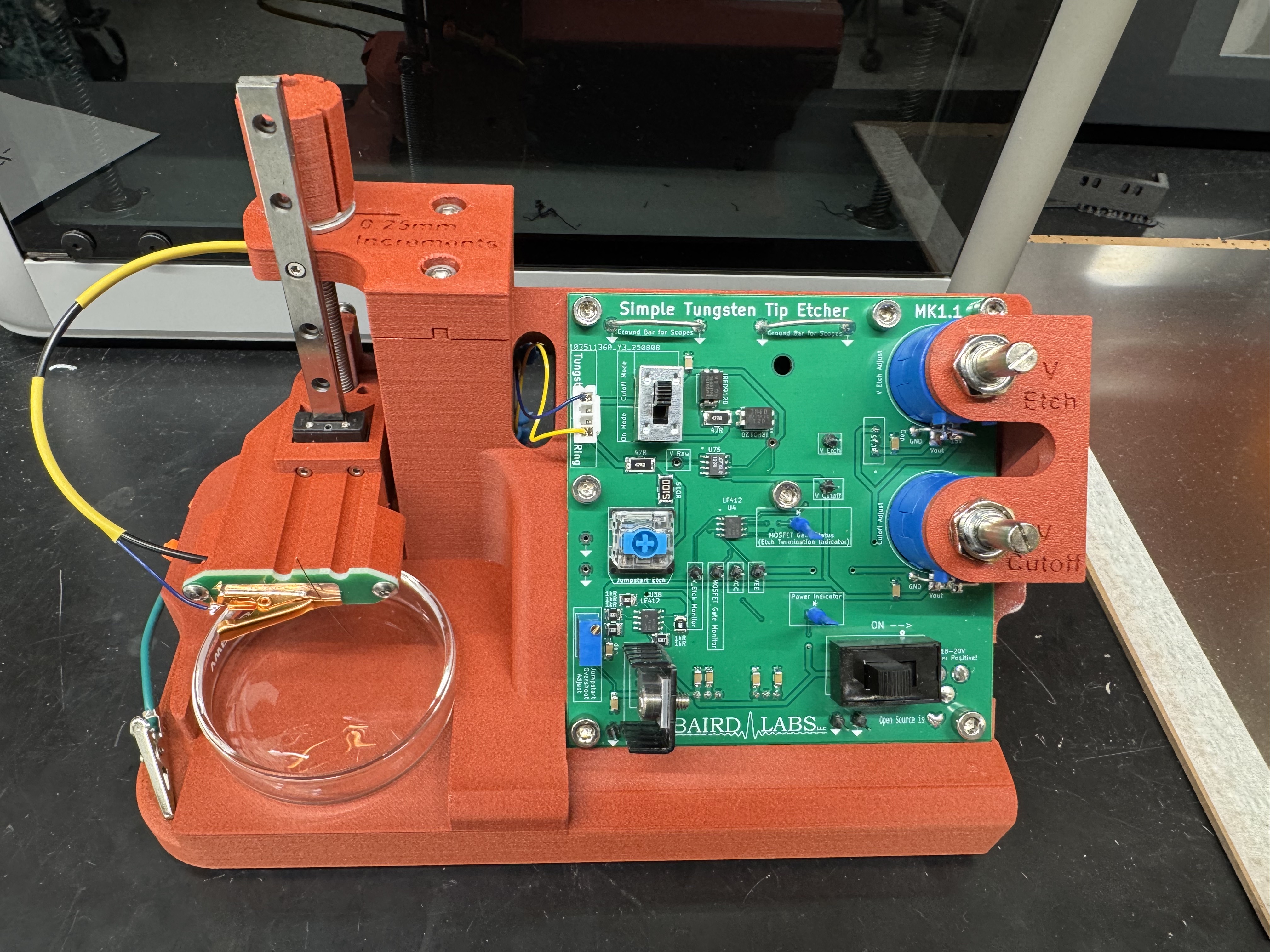
<table data-header-hidden><thead><tr><th width="129.6796875"></th><th></th></tr></thead><tbody><tr><td><strong>Date</strong></td><td><strong>Item / Notes</strong></td></tr><tr><td>09/08/2025</td><td><p><strong>Purchase Order</strong></p><p>• Contacted BairdLabs via WhatsApp and placed an order for the Simple Tungsten Tip Etcher Kit</p></td></tr><tr><td>09/29/2025</td><td><p><strong>Assembly</strong><br>• Received shipment from BairdLabs LLC</p><p>• Assembled Baird Labs Simple Tungsten Tip Etcher kit following official build-guide video from bairdlabsllc.com.</p><p>Build Guide: <a href="https://youtu.be/4HjVKDu4558">https://youtu.be/4HjVKDu4558</a><br>• Full Assembly completed. Kit included all necessary mechanical and electrical components—no additional parts required.<img src="/files/1NE4jPtEhnlK6Os8W1fF" alt=""></p></td></tr><tr><td>10/19/2025</td><td><p><strong>Cathode Ring Issue</strong><br>• Discovered that the stainless-steel cathode ring arrived slightly deformed from shipping, causing improper fit in the provided glass beaker.<br>• Attempted reshaping; glass beaker cracked during refitting.<br>• Contacted Baird Labs — vendor acknowledged issue and shipped replacement ring and beaker with looser tolerance for future customers. </p><p></p><p><strong>Ring Fabrication Contingency</strong><br>• For other hackers, here is a fabrication procedure if unable to procure replacement from vendor and issue persists:<br> 1. Measure inner circumference of electrolyte beaker.<br> 2. Cut stainless-steel strip slightly longer than circumference.<br> 3. Use ring roller to form consistent curvature.<br> 4. Spot-weld overlap to close the loop and ensure conductivity.</p></td></tr><tr><td>10/24/2025</td><td><strong>Replacement Ring + Glass Beaker Arrived</strong></td></tr><tr><td>10/26/2025</td><td><p><strong>Calibrated Tip Etcher</strong></p><p>• Followed Baird Labs Calibration and Tip Etching Demo: <a href="https://www.youtube.com/watch?v=jelE-ZIFsOY">https://www.youtube.com/watch?v=jelE-ZIFsOY</a></p><p>• Used Oscilloscope found in Hacker Fab</p><p>• Determined Cutoff Voltage to be 1.5V and Etching Voltage to be 12V using methedology presented in video and presented here:  <a href="https://drive.google.com/file/d/1LRynwpiyUP5ScslUSudtvaZtcyXq-GqG/view?usp=sharing">Link</a></p></td></tr><tr><td>11/09/2025</td><td><p><strong>Etched Atomically Sharp Tips</strong></p><p>• Followed our Hacker Fab Authored "How To Etch a Tip" Manual, integrating an Analog Discovery 3 and a laptop for repeatable etching. Full Steps outlined here: <a href="https://docs.google.com/document/d/1ji6zXpSCL5voDufHoooTXZGm6x2SABcdQe3HTDDaP_M/edit?usp=sharing">link</a> </p></td></tr><tr><td>11/10/2025</td><td><p><strong>Characterized Atomically Sharp Tips</strong></p><p>• Imaged our Tips using CMU MCF, discerned an upper bound on sharpness to be below 50nm in tip radius. </p><div><figure><img src="/files/jymSRWfAZ9itTDhzjrzq" alt=""><figcaption></figcaption></figure><figure><img src="/files/6KHU9U9VPauhvTv8D4ZS" alt=""><figcaption></figcaption></figure></div></td></tr></tbody></table>
#### **Development Log — Positioning System - Replicable Progress with Unforseen Challenges**

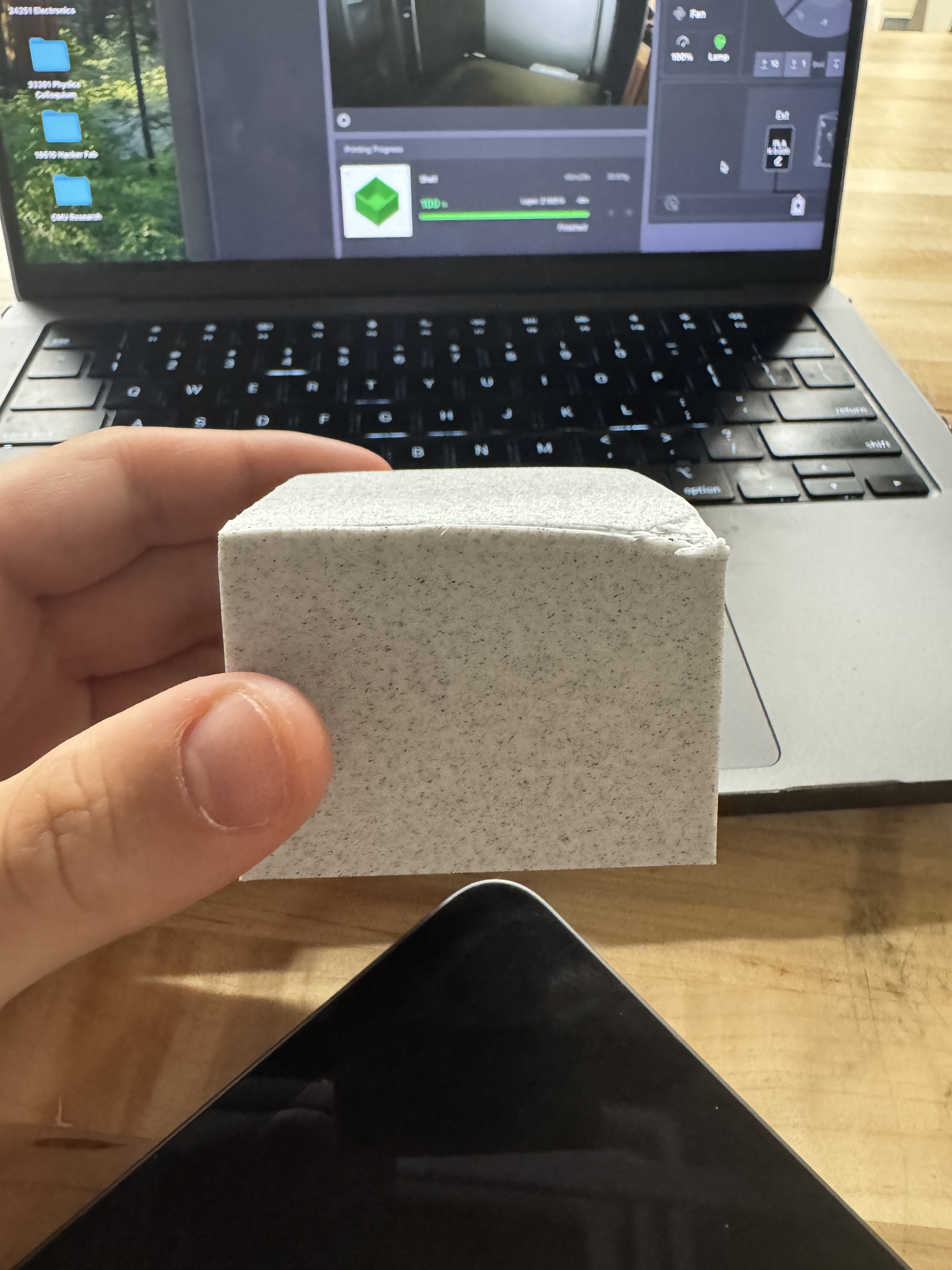
<table data-header-hidden><thead><tr><th width="129.75"></th><th></th></tr></thead><tbody><tr><td><strong>Date</strong></td><td><strong>Item / Notes</strong></td></tr><tr><td>09/08/2025</td><td><strong>Hardware Procurement</strong><br>• Created and finalized the <a href="/spaces/XgXjz6D0Vz2o0EOp8JO5">Positioning System Bill of Materials (BOM)</a>, listing all required fasteners,  aluminum, and piezo actuators.<br>• Ordered all parts from vendors that sell into the U.S. market, including McMaster-Carr and Digi-Key.</td></tr><tr><td>10/05/2025</td><td><p><strong>3D Printing — Shell and Shell Cover</strong><br>• Printed the shell and shell cover in <em>PLA</em> on a Bambu X1 Carbon while awaiting shipment of mechanical parts<br>• STL files: <a href="https://drive.google.com/file/d/1fhlYp_1goYWuoimJqB0hcIpVkTQEOxQ1/view?usp=drive_link"><code>Shell.STL</code></a>, <a href="https://drive.google.com/file/d/1j3fJhVKRkAiHV2iVulpom9rleipbWgkW/view?usp=sharing"><code>Shell_Cover.STL</code></a>.<br>• Shell: Grey PLA — 215 °C nozzle / 50 °C bed, 30 % infill, brim adhesion, 43 min.<br>• Shell Cover: White PLA — 200 °C nozzle / 60 °C bed, 10 % infill, brim adhesion, 50 min.</p><p><strong>Printing Issue and Remedy:</strong></p><div><figure><img src="/files/EiQFjxgtu99fdYiyurDK" alt="" width="188"><figcaption></figcaption></figure></div><p><br>• Slight corner warping observed on the shell-cover; plan to increase bed temperature to 55 °C and widen brim adhesion in future prints.</p></td></tr><tr><td>11/10/2025</td><td><p><strong>Reprinted Shell and Shell-Cover</strong></p><p>• Printed the shell and shell cover in <em>PLA</em> on a Bambu X1 Carbon while awaiting shipment of mechanical parts<br>• STL files: <a href="https://drive.google.com/file/d/1fhlYp_1goYWuoimJqB0hcIpVkTQEOxQ1/view?usp=drive_link"><code>Shell.STL</code></a>, <a href="https://drive.google.com/file/d/1j3fJhVKRkAiHV2iVulpom9rleipbWgkW/view?usp=sharing"><code>Shell_Cover.STL</code></a>.</p><ul><li>Used what we learned about settings from our attempt on 10/05/2025</li></ul><div><figure><img src="/files/NptWETmI71d0jqPguJav" alt=""><figcaption></figcaption></figure></div></td></tr><tr><td>12/01/2025</td><td><p>CNC'd the Aluminum Components</p><p>• Printed the alumunum components found here: <a href="https://drive.google.com/drive/folders/1E_MRQJIctkETBR0F1AxWQZVB8PpIxnKa?usp=drive_link">link</a> </p><div><figure><img src="/files/DC0Ih3JW4LDOhdwu8aUB" alt=""><figcaption></figcaption></figure></div></td></tr><tr><td></td><td></td></tr></tbody></table>


---

# Agent Instructions: Querying This Documentation

If you need additional information that is not directly available in this page, you can query the documentation dynamically by asking a question.

Perform an HTTP GET request on the current page URL with the `ask` query parameter:

```
GET https://docs.hackerfab.org/home/fab-toolkit/metrology-characterization/scanning-tunneling-microscope.md?ask=<question>
```

The question should be specific, self-contained, and written in natural language.
The response will contain a direct answer to the question and relevant excerpts and sources from the documentation.

Use this mechanism when the answer is not explicitly present in the current page, you need clarification or additional context, or you want to retrieve related documentation sections.